In This Article
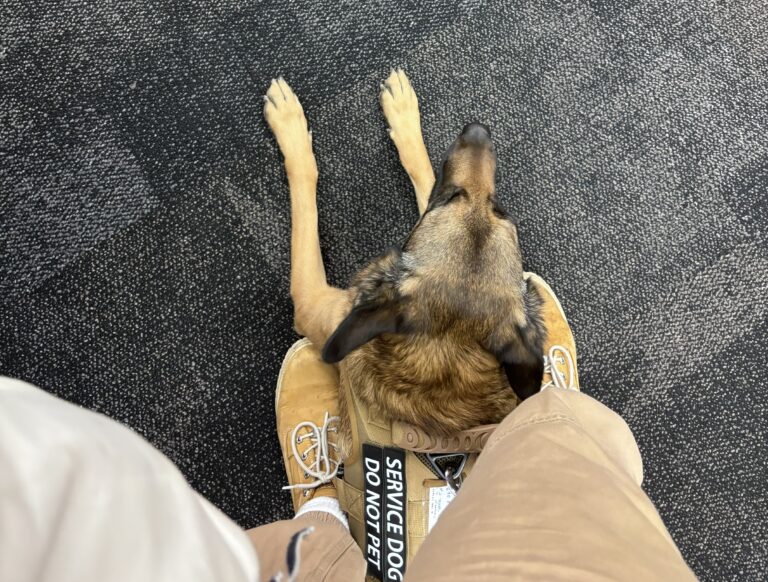
Owner-training a service dog is an increasingly popular path for people who need a mobility, psychiatric, or other service dog. Unlike hiring a professional trainer or purchasing a pre-trained dog from an organization, owner-training allows you to work directly with your own dog from the beginning, creating a unique bond while developing the specific skills your dog needs to support you.
What is Owner-Training?
Owner-training is the process of training your own dog to perform tasks to aid you with your disability rather than relying on a professional trainer or service dog organization to complete the entire training regimen. This approach gives you complete control over the training process, allows you to customize the dog’s tasks to your specific needs, and typically costs significantly less than purchasing a pre-trained service dog.
The key advantage of owner-training is that you work with your own dog, often from puppyhood or from the time you adopt them. This creates a deep bond between you and your service dog while you guide every aspect of their training.
The Owner-Training Timeline
Understanding the timeline for owner-training is essential for setting realistic expectations. Most owner-trained service dogs take 18 to 24 months of consistent, dedicated training to reach full task reliability.
Brainstorm Your Service Dog’s Tasks
Start working with The Sharp K9 to brainstorm the tasks you need your future service dog to perform to aid you in your disability. Make sure that you take a service dog trainer with you to evaluate puppies as potential service dog placements. This is called a “Puppy Eval”. This is essential to ensure your new puppy’s temperament will mesh well with service work.
At The Sharp K9, we divide tasks into 2 types. Low-Risk Tasks, and High-Risk Tasks. We recommend only training low-risk tasks yourself.
Low-Risk Tasks
- Medical Alerts
- Panic attacks
- Migraines
- Narcolepsy
- Flashbacks
- Light Mobility
- Picking up & retrieving items
- Counter-balance
- Forward Momentum
- Sensory Alerts
- Person entering the space
- Person following
- CO Alarm response
- Fire Alarm response
- Behavior Interruption Alert
- Doom scrolling
- Scratching
- Reaching for alcohol
- Vaping
- Nail biting
- ‘Zoning out’
- Teeth chatter
- Hyper- or Hypo-ventilation
- Over-stretching
- Self harm
- Reminders & Timed Alerts
- Take medication
- Get the mail
- Remember to eat
- Remember to drink water
- Self-care reminders
- Exercise reminder
High-Risk Tasks
For high-risk tasks, we recommend finding an organization for help. If your dog is to miss one of these tasks, the result could be life-threatening.
- Medical Alerts
- Seizures
- High/Low blood sugar
- Fainting/POTS
- Severe Allergen Detection
- Mobility
- Guide dogs
- Wheelchair Pulling
Tasks we don’t recommend training in service dogs, or may be illegal to train in a service dog:
- Protection/Attack
- High-drive bite work
- Herding
- Livestock guardianship
- Hunting/pest control
Choose Your Service Dog’s Breed
Most accredited Service Dog organizations and knowledge centers recommend choosing one of the Fab Four breeds for service work:
- Golden Retrievers
- Standard Poodles
- Collies
- Labrador Retrievers
However, depending on the nature of your disability, you may need to be creative with your choice of breed. Click this link to view a brief outline on highly recommended small dog breeds for service work.
The types of breeds we DO NOT recommend for service work are as follows:
- Scent-Hounds
BeagleCoonhoundBloodhoundBasset Hound
- Terriers
Jack Russell TerrierAiredale TerrierBoston TerrierRat TerrierWelsh Terrier
- High-drive herding dogs
Belgian/Dutch ShepherdsBorder ColliesAustralian ShepherdsGerman Shepherds
- Guardian Breeds
Great PyraneesCane CorsoChow ChowAkita- and Shiba- Inu
First 6 Months: Foundation and Basic Obedience
During the first six months, focus on establishing a solid foundation. Your dog should master basic obedience commands: sit, down, stay, leave it, heel, and reliable recall. These foundational skills form the basis for all future service dog training.
During this period, you’ll be exposing your dog to various stimuli, like busy parks, new sounds, and new tactile experiences. This is called Sensory Exposure, and must be paired with Shaping. Shaping means gently rewarding your dog for engaging in behavior you want them to repeat. Don’t make your dog excited to experience new things, make those things seem mundane, and reward them for calm reactions.
Months 4-12: Task Introduction and Skill Development
Slightly overlapping with initial basic obedience, you can begin introducing specific service tasks. This is where the training becomes highly individualized. You should have already identified the tasks your dog needs to perform to mitigate your disability and begin breaking them down into manageable steps. Service Dog tasks should only be taught through luring, operant conditioning, and praise. Utilizing strict punishment or harsh conditioning methods will cause your dog to hesitate when performing their tasks.
Months 9-18: Public Access Training and Proofing
Public access training becomes the main focus during this period. Your dog needs to demonstrate perfect behavior in all public settings—restaurants, stores, medical facilities, public transportation, and anywhere else you might need them. This requires extensive practice in increasingly challenging environments. Your dog must not only behave well in these places, but also be able to perform their tasks under any amount of distraction. This process is called “Proofing”.
Months 18-24: Polishing and Advanced Skills
The final months are about perfecting performance. Your dog should be performing all tasks reliably, maintaining excellent public access behavior, and generalizing their skills to new situations without hesitation. By the end of this period, your dog should function as a fully trained service dog.
Legal Rights of Owner-Trained Service Dogs
Under the Americans with Disabilities Act, service dogs in training have different protections depending on your state. However, once your dog is reliably performing at least one task that mitigates your disability, they are considered a service dog under federal law and have full public access rights. You do not need certification, registration, or special identification. Service dogs are identified by their behavior and training, not by vests, certificates, or ID cards.
If someone you know has purchased an ID card for easier Service Dog access, calmly inform them that they were scammed. This practice is not regulated by the government, and makes access more difficult for other handlers.
Getting Started with Owner-Training
Choose the right dog candidate with appropriate temperament. Not every dog has the right disposition for service work. Look for dogs who are confident but not overly excitable, friendly but not overly social, and resilient in new situations. Work with a professional to get your future puppy evaluated before you bring them home. While owner-training means you do most of the work, professional guidance can prevent mistakes and accelerate progress. At The Sharp K9, we specialize in supporting owner-trainers through every phase of the process.
Ready to begin your owner-training journey? Contact The Sharp K9 for expert guidance on owner-training your service dog. Our trainers can help you assess your dog, develop a training plan, troubleshoot challenges, and ensure you and your dog succeed.
Need Professional Help?
Our team is ready to assist with all your pet care, training, and service dog needs.
Book a Free Consultation
Written by
necati turanExpert in holistic pet care, dog training, and service dog support at The Sharp K9.
View all articlesRelated Articles
View All